Pembrokeshire day three – 9th Oct 2011
Day three itinerary
Breakfast 0700
Leave by coach 0745.
Arrive Marloes Sands.
Packed Lunch on coach.
Leave Marloes for Martin's Haven and Wooltack Point.
Leave Wooltack Point for St Anne's Head.
Potential visit to Skrinkle Haven on way back.
For the information on the day provided by Bill Fitches, our geological guide for the day, click here.
Write up of day three by Liz Daniel and Brian Roberts
Our guide for this trip was Bill Fitches, a former lecturer in geology at Aberystwyth University, who had also worked in Industry and Conservation. He had brought his students to Marloes Sands many times so was very knowledgeable and informative but still seemed able to communicate to people with limited experience - in spite of competing with the noise of the wind and waves.
Initially, Bill painted a picture of late Ordovician to late Silurian times (very approximately 440 to 410 million years ago). Most of the rocks we would see here belong to the Skomer Volcanic Group (SVG). These formed when a group of volcanic islands produced lava flows which cooled to form igneous rocks and other volcanic material e.g. ash and rock fragments which were laid down in a shallow sea and ultimately formed sedimentary rocks. These were later overlain by the Coralliferous and Grey Sandstone Groups and the desert deposits of the Old Red Sandstone (ORS). Subsequently, they were all folded, split, and generally disturbed during the Variscan Orogeny (late Carboniferous, approx 300 million years ago) due to plate tectonic movements.
Our First Stop was at the eastern end of the Bay, where older rocks lay to the west and younger ones to the east. The main points of note were: The contrast between the vertical sandstones and shales with the harder red rocks of the headland (ORS). Also the contrast between the bedded sediments and the massive homogeneous rocks of the igneous basalt was clearly evident. The latter were made from the original lava which had cooled rapidly thus forming very small crystals within it. We noticed small angular orange bits, phenocrysts, which had formed particularly early. Also, in some areas were small holes known as vesicles, which had been gas bubbles in the original lava. Green veins of white quartz and green epidote were observed – these were a later intrusion into cracks in the rocks, which formed as the lava cooled.
Second Stop (further west)
We were still in the SVG sequence but the rocks here were mainly sedimentary. Sediment was washed down from the volcanoes and then spread out to form layers of sands and muds. Eruptions from time to time would form layers of ash. The rocks here were vertical, the result of the later Variscan Orogeny.
Third Stop (again moving further west)
Again, the cliffs comprised near vertical strata. Bill pointed out one stratum of conglomerate which would have formed over a long time on a beach as the pebbles it contained were well-rounded and close together. Another rock had rounded and more widely-spaced pebbles but was much darker – it would have formed in muddy, turbulent conditions. Usually mud, which comprises of very small particles , is deposited over time in quiet water. Fossils in these rock are quite rare and we did not find any.
Fourth Stop
Bill informed us that there was a major junction or unconformity here but it was difficult to see. It seems that the sedimentary rocks of the Skomer Volcanic Group were eroded and tilted slightly at an angle of 5 degrees from horizontal by faulting before being re-submerged under the sea. After a gap of a few million years, the Coralliferous Group was laid on top.
Fifth Stop
Finally we explored rocks of the Coralliferous formation, which formed under shallow marine conditions in warm subtropical seas. Such conditions are favourable to life and as a result fossils could be found. Also visible were the burrows of sea creatures and rocks with shell debris. High up on one of the now near-vertical cliffs was an area of ripple marks of an old sea shore, proof if any more was needed that this surface must have been at one time lying horizontally.
Although further exploration to the east had been planned, it was decided at this point to leave the beach and the somewhat windy conditions and return up the cliffs to our coach.
Liz Daniel (morning)
In contrast with the Pre-Cambrian and Cambrian rocks at Whitesands bay, the cliffs at Marloes Sands presented us with spectacular later formations of Silurian sandstones and conglomerates of the Skomer Volcanic Group (SVG) which surprisingly include sedimentary components. The impressive bedding planes, tilted almost to the vertical, are tens of metres high and young out to sea and towards the east end of the bay.
The most prominent feature is the “Three Chimneys”: three sandstone edges of bedding planes interspersed with softer sandy mudstones rising to the full height of the cliff face. A prominent unconformity of 50 to 100 to a shelly bed was also observed.
The coralliferous mudstones are consistent with estuarine shallow water silting which has been consolidated into mudstones which were later eroded in dry desert conditions near the equator forming sand and subsequently sandstone.
The estuarine phase is evident through
a) fossilised worm burrows now preserved as hollows restored after an intervening filling of mud has been flushed out by water flows, and
b) cross bedding revealing tidally excavated sand ripples in at least one case preserved as a herringbone pattern characteristic of sequential ebb-flow tidal currents. Several clear crinoidal fossils were also seen.
The old red sandstone with feldspar/quartz intrusions is attributed to a dry desert scenario punctuated by occasional flash floods evidenced by some cros(s)-bedded flow channels, distinct from areas of quiet deposition.
The scale and global significance of the Marloes Sands formations were emphasised for us by discovering that we had to compete for space on the exposures with a large contingent of Oxford students and also a small group based in Uppsala, Sweden!
Martin’s Haven
A few miles to the north we examined the basaltic and pyroclastic flows of the SVG group at Martin’s Haven, whilst being supervised by a curious seal puzzled to see tourists so late in the season.
Cobbler’s Hole at St Anne’s Head
In spite of a Force 10 wind, we were able to marvel at the magnificently exposed anticline-syncline pair with noticeable crushing of the rocks inside the fold of the syncline. This is a result of the Variscan Orogeny.
Brian Roberts (afternoon)
Pictures from day three
Marloes Sands
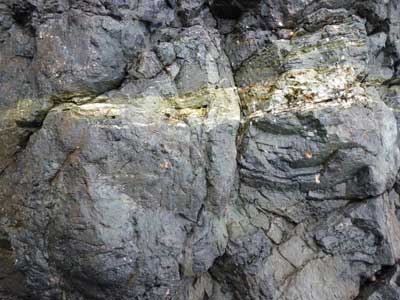
Green veining filled with epidote within the igneous
basalt.
Note also phenocryts within the basalt. Gas bubbles (vesicles) are also visible.
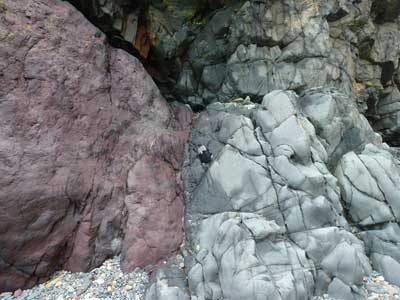
Igneous basalt from the Skomer Volcanic Group.
Indication of secondary lava flow, the red is the initial flow.
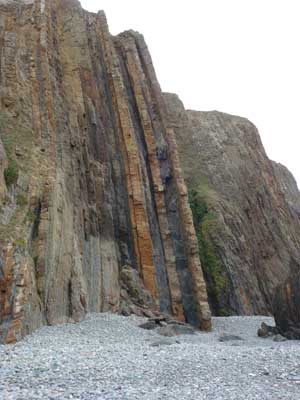
The Three Chimneys. Three columns of ferruginous sandstone.
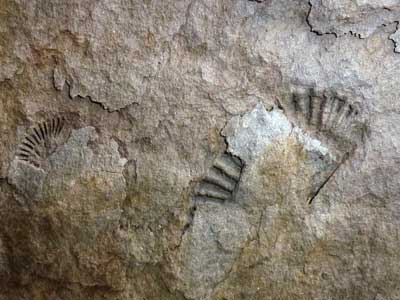
Palaeocyclus, an early Silurian coral, in the Coralliferour Group.

Worm burrows in Grey Sandstone.
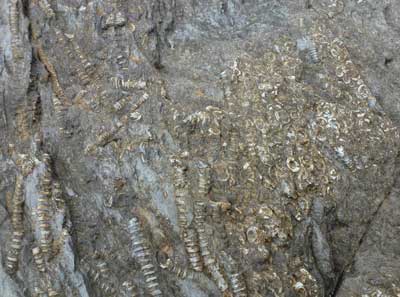
Crinoids in Grey sandstone.
Martin's Haven

Martin's Haven.
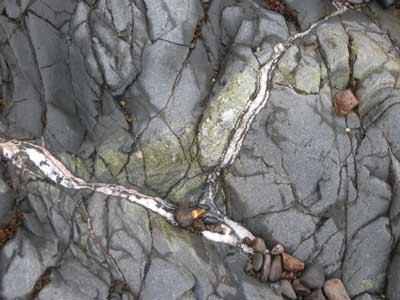
Epidote within the basalt flow on the beach.

Pyroclastic tuff with conglomerate, probably originally from a beach.
Cobbler’s Hole
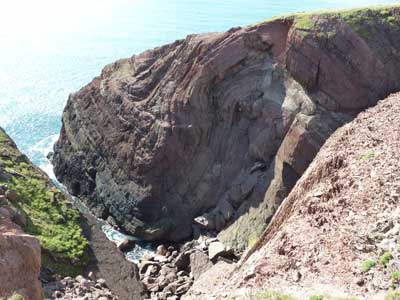
The anticline-syncline pair